There is still weed at your pike spot, but gaps are opening between the plants. Some places can now be fished where every cast came back covered in weed a few weeks ago. Before your first cast, look for room to work your lure. That determines whether you can let it glide sideways, retrieve it steadily or let it sink during a pause.
First, find a clear route for the lure
- 1
Look for a clear lane along the weed edge or above the plant tips.
- 2
Cast so that your lure stays in that lane for as much of the retrieve as possible.
- 3
Check the hooks after retrieving. If weed comes back with the lure, change your casting angle or run a little shallower.
- 4
If the route is still too tight, find another gap.
Once the lure runs cleanly through it, you can make a useful comparison with a different lure action.
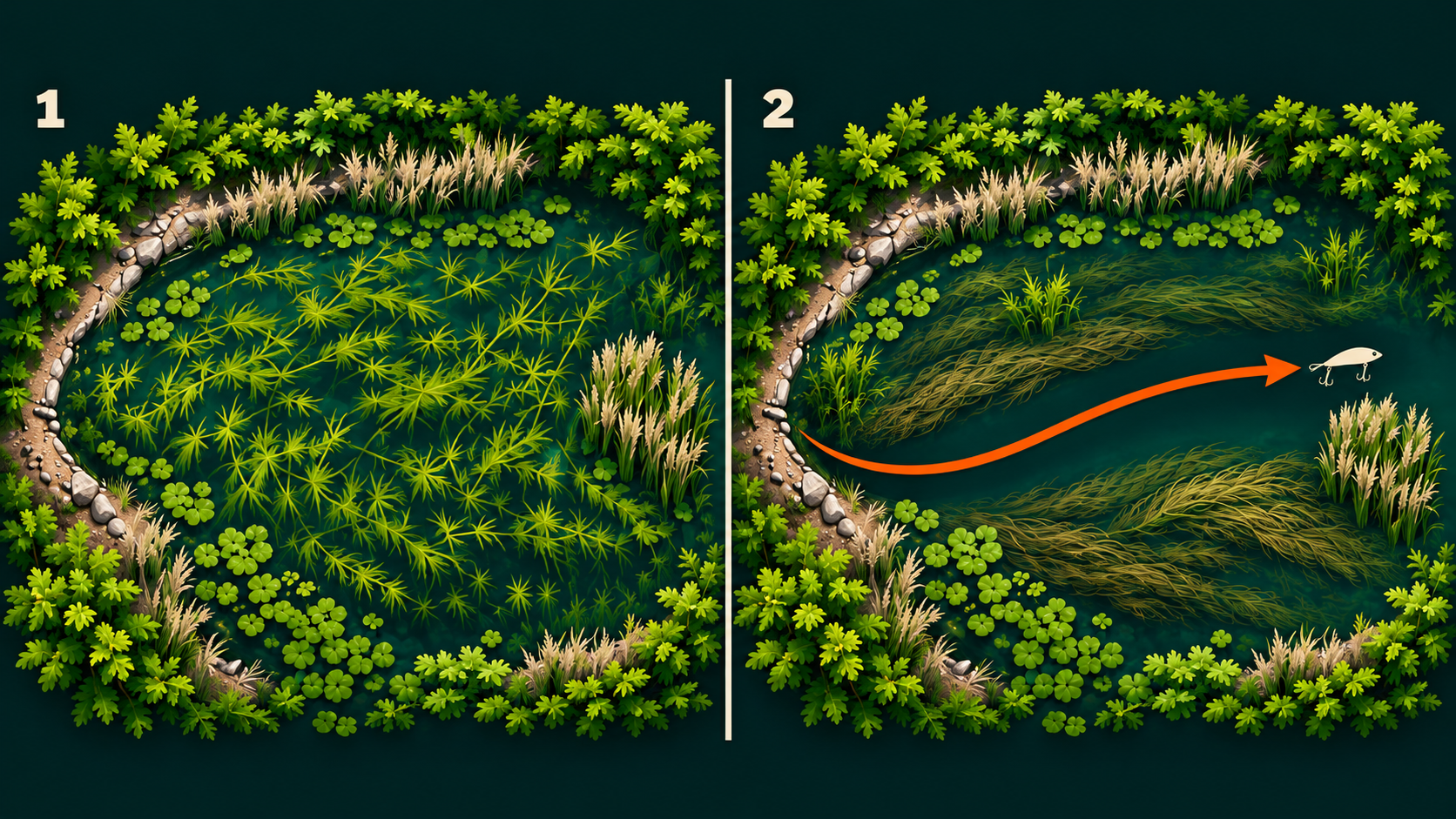
As plants collapse, new clear lanes can open. The illustration shows one example.
Tall weed leaves little room for sinking
Where plants reach high into the water, try a floating glidebait. Models between 10 and 18 cm offer a useful starting point. What matters is how far the lure moves sideways and what it does when stopped. A wide gap gives you room to use its gliding action. In a narrow passage, that same action would keep taking it into the weed.
For a narrow lane, I would first retrieve a paddle-tail softbait steadily above it. That lets you cover the route without wide sideways movements. Around 14 to 20 cm gives you a practical initial selection. Choose the weighting so that the lure stays above the plants at your retrieve speed, with the tail working properly.
This example shows how much room remains below:
Reference point | Depth below the water surface |
|---|
Lake bed | 2.5 m |
Weed tips | 1.0 m |
Lowest hook | 0.6 m |
That leaves 40 cm between the hook and weed. A sinking lure can use up that space quickly during a pause. Over this spot, I would start without long sinking pauses.
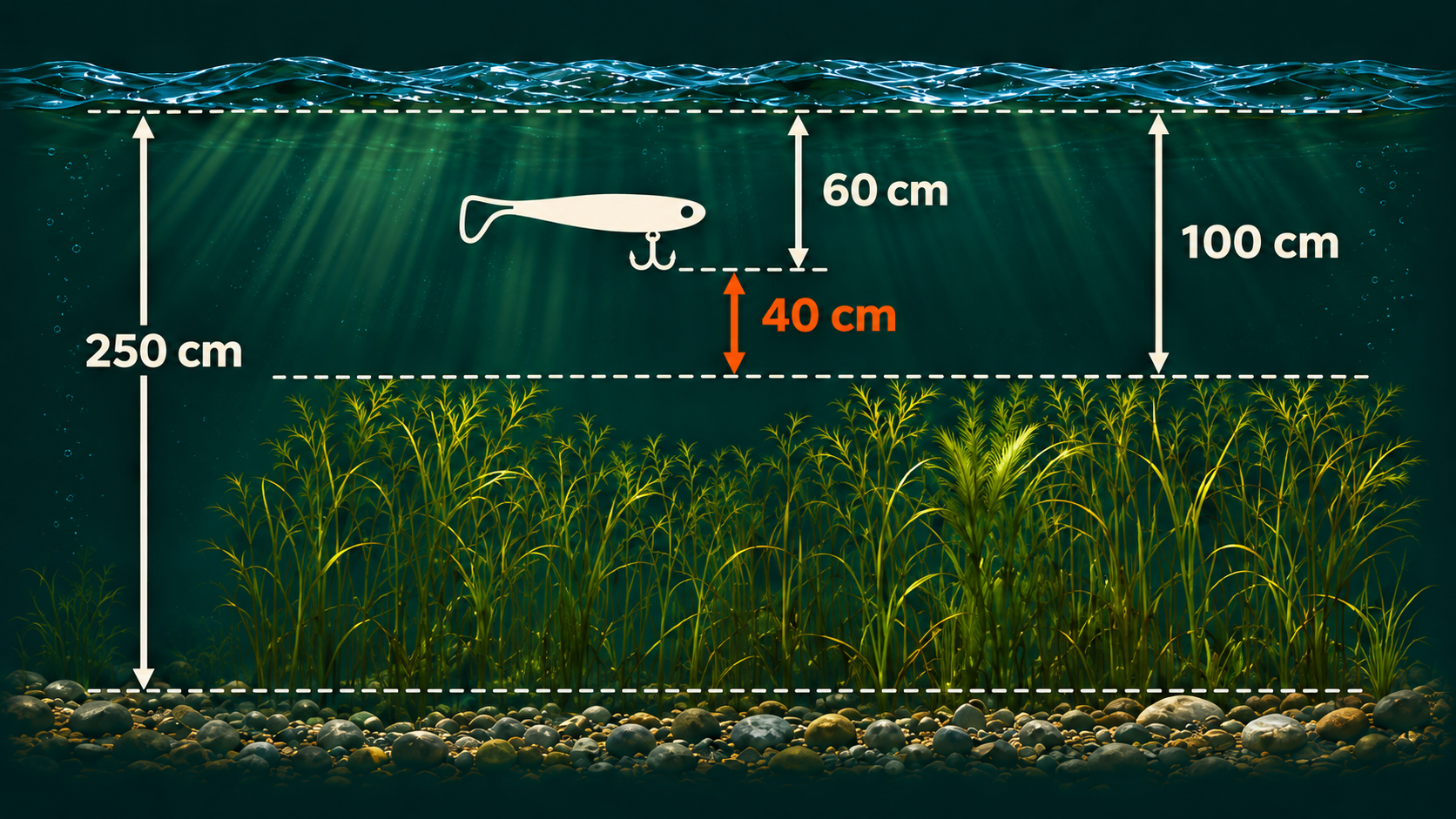
Measure to the lowest hook. The depths are example values; the illustration is not to scale.
Change the action along an open route
An open outside edge gives you more options. If you want to cover it with a steady retrieve and add flashes of light, a spinnerbait is a good choice. Check over the first few metres that its blades rotate at your intended speed. Work it through clear water rather than pulling it through dense plants.
Where there is enough room below the lure, you can fish a sinking tailbait with short pauses. With a model whose tail also works on the drop, the lure keeps moving during the pause. This lets you try a different retrieve along the same route. Make sure the pause ends above the plants.
The water beside the weed may be deeper
Where the bottom drops away beyond the weed edge and the route stays clear, a deeper-running hardbait becomes an option. If you see small fish there, work the clear lane beside them. Choose a hardbait whose running depth suits that area.
A lure that runs around 2 m deep on the retrieve needs a suitably deep, unobstructed route. It would run too deep above the weed tips at 1 m in the earlier example. A floating hardbait rises when it is no longer being pulled. Its diving lip takes it down during the retrieve.
Make a quick check before casting
Test the lure in visible water with the pike-resistant leader you will use when fishing. Watch how it works at a slow retrieve and whether it rises or sinks when stopped. This helps you judge whether it fits your chosen route.
With an unrigged softbait, hooks and weights add to the body weight. A pre-rigged lure saves you that assembly. In either case, the complete casting weight must suit the rod. Also check the leader, snap and hooks for damage, and close the snap fully.
Start with a lure you can work cleanly through the spot. If it stays free of weed, you can change the speed and pauses.
